Loren Carpenter didn't just work in computer graphics — he helped invent the field as we know it. A founding employee and chief scientist of Pixar Animation Studios, Loren co-developed the Reyes rendering architecture and was a principal architect of RenderMan, the software that brought photorealistic imagery to film for the first time and went on to render nearly every Pixar movie ever made.
His career began not in animation but at Boeing, where he worked as a computer operator while earning his degrees in mathematics and computer science from the University of Washington. It was there he began pushing for computers to replace hand-drawn engineering — an early sign of the instinct that would define his life's work: seeing further than the tools currently allowed. That instinct extended beyond software: he was immediately smitten with hang gliding, built his own kite — one he proudly claimed could handle 9Gs — and flew it over a hundred times. The experience turned out to be more than a hobby — the feeling of flight he developed in the air became the direct inspiration for Vol Libre's camera paths.
In 1980, that two-minute film — a soaring flight over fractal mountains rendered entirely by software he wrote himself — stunned the audience at SIGGRAPH and earned a standing ovation. It also got him hired on the spot by Lucasfilm's Computer Division, the group that would become Pixar. Two years later, he helped create the "Genesis Effect" sequence in Star Trek II: The Wrath of Khan, one of the first fully fractal-generated landscapes ever put on screen — and still considered a landmark moment in visual effects history.
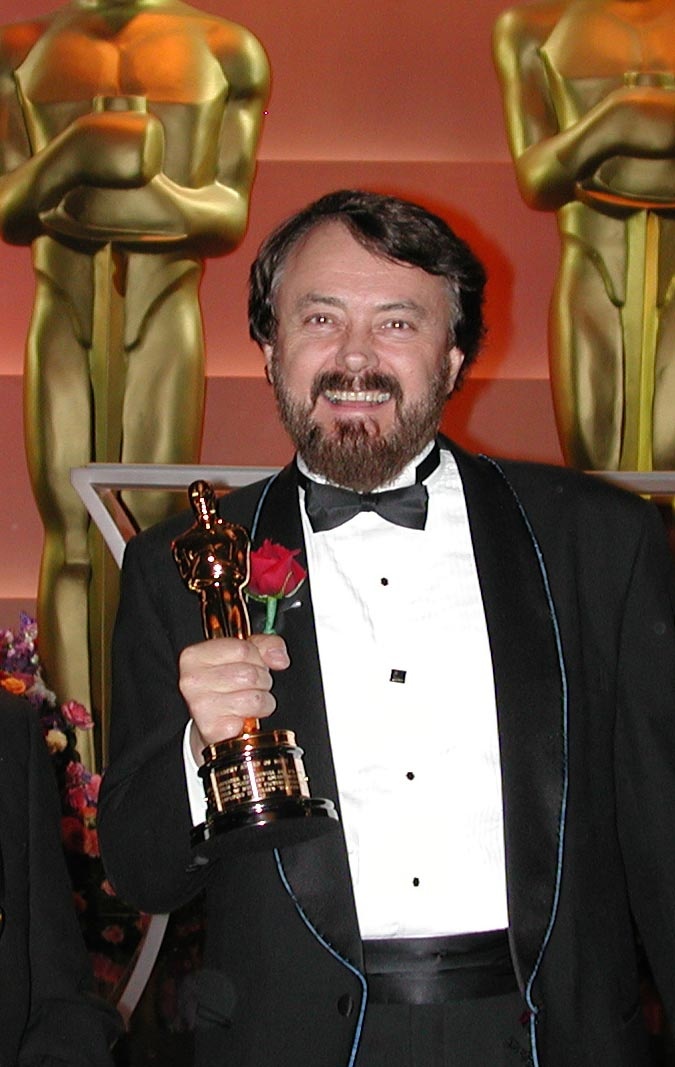
Over the decades that followed, Loren's fingerprints touched an extraordinary run of films: André & Wally B., Toy Story, Monsters, Inc., Finding Nemo, The Incredibles, Cars, Up, Brave, and many more. He also invented the A-buffer antialiasing algorithm, co-developed distributed ray tracing, and later contributed improvements to the Mersenne Twister random number generator — each a quiet but foundational piece of the technology that powers modern computer graphics. His work earned him two Academy Awards: a Scientific and Engineering Award in 1993 for RenderMan, and the Academy Award of Merit in 2001.
True to form, Loren never stopped exploring the edges of what was possible. After retiring from Disney/Pixar in 2014, he joined the Institute of Noetic Sciences as a research scientist, turning his fabrication and engineering skills toward the study of consciousness itself. He also co-founded Cinematrix with his wife, Rachel, pioneering technology for large-scale interactive audience participation. As he put it in a recent interview, "I followed my passion. I paid attention to the world around me and came back to anything that I found excited me. I had a hell of a lot of fun."
Loren saw little difference between art, science, and wonder — to him they were the same pursuit, approached from different angles. He is survived by his wife, Rachel; his son, Tay, and daughter-in-law, Mara; his brother, Bruce, and sister-in-law, Helen; and his niece, Autumn, and nephew, Brian. That curiosity and the generosity with which he shared it are the legacy he leaves behind.